


Dental Implant Specialist in La Crescenta for Missing Teeth

A missing tooth can affect more than your smile’s appearance. A dental implant replaces the tooth root with a post in the jawbone, which can support a crown or another restoration. If you’re considering implants at Crystal Bright Smile in Tujunga, understanding how they work is a useful first step.
It’s natural to want a replacement that feels stable and looks at home in your smile. Implant treatment is planned around your oral health, available bone support, and the number of teeth being replaced, so the right approach varies from person to person.
This guide explains what dental implants are, how they can replace one or more missing teeth, and what can shape treatment planning and healing. You’ll also learn what to expect from an implant evaluation and how Crystal Bright Smile in Tujunga serves patients from La Crescenta.
Table of Contents
What Are Dental Implants?
A dental implant is a titanium post placed in the jawbone to act as an artificial tooth root. Once bone attaches around it, the implant can support a crown, bridge, or denture. Coordinated planning connects the surgical placement with the shape, position, and function of the final restoration.
During a consultation, the dental team reviews your oral health, missing teeth, goals, and clinical needs. Planning also considers bone support and gum condition. The surgical plan identifies where an implant may be placed, while the restorative plan considers how the replacement tooth will fit your bite and smile. Coordinating these plans keeps each treatment stage focused on the intended restoration.
When comparing an oral surgeon, periodontist, and prosthodontist, consider which parts of treatment each manages and how the surgical and restorative plans connect. An oral surgeon focuses on surgical procedures, a periodontist on gums and supporting tissues, and a prosthodontist on tooth replacement and restoration design.
Patients from La Crescenta may seek implant care from oral and maxillofacial surgeons, periodontists, or dentists experienced in implant restoration. Dr. Souren Rostomyan is a board-certified oral and maxillofacial surgeon serving the area from Tujunga.
To review a California dentist’s license, use the Dental Board of California’s license lookup. Check license status separately from specialty credentials or additional training, since they describe different qualifications.
Among the local provider credentials, Dr. Souren Rostomyan is board-certified in oral and maxillofacial surgery. His background also includes more than 20 years of experience and an Associate Professor role at Loma Linda University.
Ratings vary by review platform and can change over time. Instead of relying on one score, look for specific comments about communication, comfort, treatment explanations, and follow-up care.
Free consultation and emergency appointment policies vary by practice. A provider’s specialty or credentials alone doesn’t establish whether either option is available.
Implant treatment happens in stages, and timing varies by patient. Bone attachment, called osseointegration, must occur before the final restoration is completed. Grafting or infection treatment can add healing time. Bone and gum condition, the planned restoration, and any additional procedures all shape the sequence.
Costs vary depending on the treatment plan, including the restoration and any additional procedures. Contact the office for a case-specific estimate. Ask how the proposed plan connects implant placement, healing, and restoration so you understand what each stage covers.
After restoration, regular brushing, flossing, and professional maintenance visits help care for implants and surrounding tissues. Peri-implantitis is inflammation around an implant that can affect supporting tissues. If gums become swollen or bleed around an implant, arrange a dental assessment; treatment depends on the condition found.
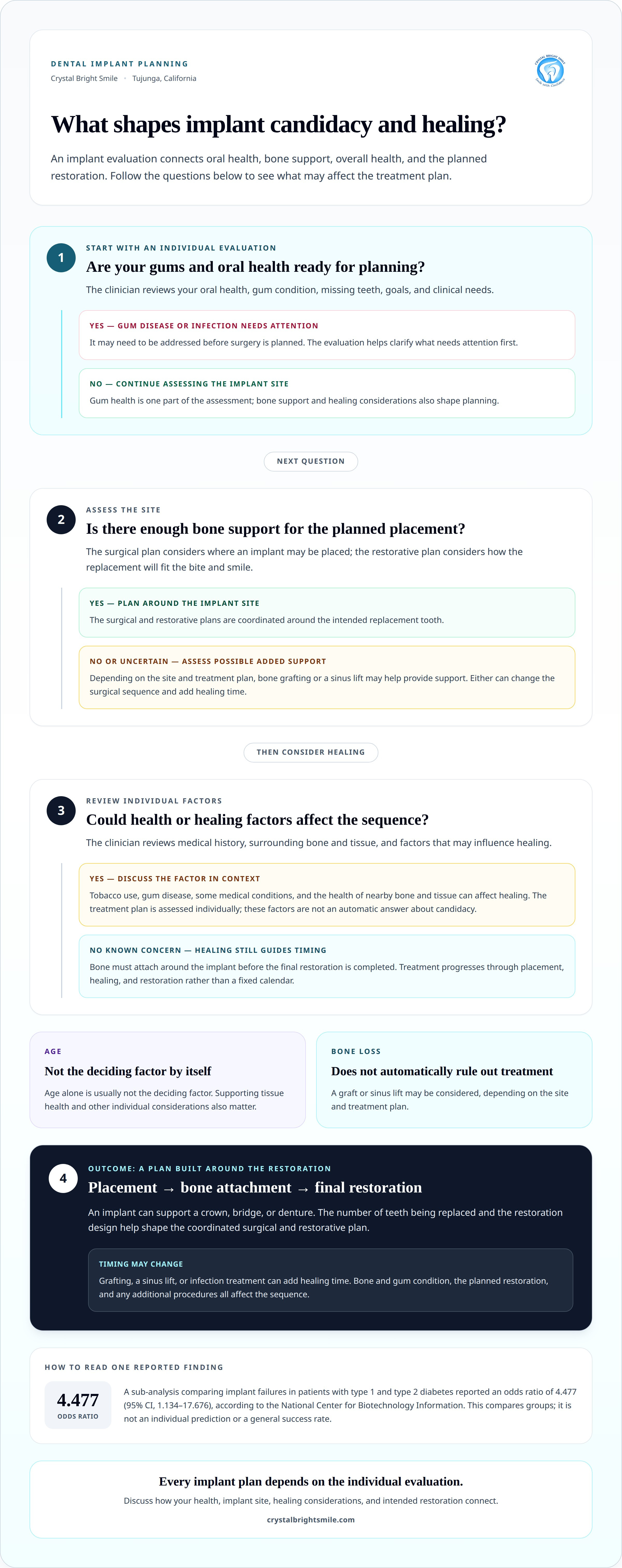
Factors that may affect healing and candidacy
Implant candidacy depends on oral health, bone support, overall health, and healing ability. A consultation considers these factors alongside your goals and the planned restoration.
Healing Timelines and Recovery
Dental implant treatment progresses through surgical placement, healing, and restoration. Bone must attach around the implant before the final tooth is fitted, so the sequence depends on healing rather than a fixed calendar. Grafting, a sinus lift, or infection treatment may add healing time. At your appointment, discuss how these steps could affect your schedule and return to normal function.
Risks and Success Rates
Healing can be affected by tobacco use, gum disease, some medical conditions, and the health of surrounding bone and tissue. A sub-analysis comparing implant failures in patients with type 1 and type 2 diabetes reported an odds ratio of 4.477 (95% CI, 1.134, 17.676), according to the National Center for Biotechnology Information. This finding compares groups; it is not an individual prediction or a general success rate.
During a candidacy assessment, the clinician reviews medical history, gum health, available bone, and factors that may influence healing. Smoking can affect healing and long-term success, so tobacco use matters in treatment planning. Age alone is usually not the deciding factor. An older adult with healthy supporting tissues may have different considerations from a younger patient with active gum disease.
Bone loss doesn’t automatically rule out implant treatment. Depending on the site and treatment plan, bone grafting or a sinus lift may help provide support for placement. These procedures can change the surgical sequence and healing timeline. The consultation should explain why additional support is being considered and how it relates to the planned restoration.
Ask how the evaluation connects your health, the implant site, and the intended tooth replacement. For example, gum disease or infection may need attention before surgery is planned. Clear steps help you understand what needs attention first, which factors could affect healing, and how treatment supports comfortable function.
Smoking can affect dental implant healing and long-term success, so the practice evaluates each case individually. That individual review keeps tobacco use in the context of the patient’s circumstances rather than treating it as an automatic answer about candidacy. Patients can discuss how smoking may figure into their assessment and treatment planning. The aim is to understand how this factor relates to healing and the proposed implant treatment, not to assume that every case will be the same.
Age alone is usually not the deciding factor in determining candidacy for dental implants. Bone loss does not necessarily rule out treatment; bone grafting or a sinus lift may help provide support for implant placement. Discuss these considerations during the candidacy assessment to understand how age and the condition of the implant site relate to the proposed plan. Asking what support may be appropriate can clarify the options and how they connect with implant placement.
Can implants support more than one missing tooth?
Yes. Dental implants can replace one missing tooth, several teeth, or support a full-arch restoration. The plan depends on the gaps, bone support, and restoration design.
Single-Tooth Replacement
For one missing tooth, an implant can support a crown without relying on neighboring teeth for support. Planning considers the gap’s position, surrounding teeth, bite, gum condition, and available bone. For example, replacing a front tooth calls for attention to alignment and appearance, while a back tooth needs to fit comfortably into chewing function. An examination helps determine whether this approach suits the site.
Multiple-Tooth and Full-Arch Replacement
When several teeth are missing, implants may support a bridge or another restoration designed to replace multiple teeth. This can avoid placing an individual implant at every gap. For a full arch, an implant-supported restoration replaces a larger group of missing teeth. The clinician considers where support is needed, how the restoration will meet the opposing teeth, and what your oral health allows.
Dental implant care in the La Crescenta area may address single-tooth, multiple-tooth, and full-arch needs. Bone grafting may be part of planning when the jaw needs added support. All-on-4 is a named full-arch approach, but the treatment design and candidacy depend on examination findings, dental condition, and clinical needs.
All-on-4 and Bone Grafting
For patients exploring a full-arch replacement, the All-on-4 approach is one option to discuss during implant planning. Bone grafting may be considered when existing bone does not provide the support needed for planned placement. These are different planning considerations: the restoration design addresses how teeth are replaced, while grafting addresses support at the implant site.
Precision matters with every option. Implant positions must support the intended crown, bridge, or full-arch restoration, with attention to bite and comfort. One missing tooth may call for a different design from several adjacent missing teeth. The treatment plan should show how the proposed implants connect to the final replacement.
Ask the clinician to explain the recommended restoration, implant locations, and any preparatory procedures. For example, a plan for a single crown differs from one replacing an entire arch. These details clarify the expected stages and how the design aims to restore stability and function.
Crowns, bridges, and implant-supported dentures
An implant replaces a tooth root and supports a restoration above the gumline. The restoration may be a crown for one missing tooth, a bridge for several, or a denture for a larger area. Choosing among them starts with the number and position of missing teeth, available support, and desired fit.
A crown is the visible replacement attached to an implant. Its shape and position are planned to meet nearby teeth and fit your bite. For example, a crown replacing a front tooth needs to align with the surrounding smile, while a back-tooth crown must fit comfortably when chewing. The dental team coordinates implant placement with the intended crown.
An implant-supported bridge connects replacement teeth across a gap. Instead of placing an implant beneath every replacement tooth, implants can support the bridge as one restoration. The number and placement of implants depend on the span, bone support, bite, and bridge design. Planning these details helps align the surgical procedure with the restoration.
Implant-supported dentures use implants for support and stability. They can replace several missing teeth or a larger section of an arch. Depending on the treatment plan and clinical needs, the design may be removable or fixed. During planning, the team considers the denture’s fit, how it will be cleaned, and how the implants will support it.
Grafting may be considered when the jaw needs additional bone support before implant placement. This can affect treatment order because the site may need to heal before an implant or final restoration is placed. For example, a proposed bridge may require grafting at an implant site. The sequence depends on the examination and planned restoration.
At a consultation, ask how the proposed crown, bridge, or denture connects to implant placement. A clear plan identifies the missing teeth being replaced, the restoration type, and any preparation, such as grafting. It should also explain how the design relates to your bite and oral health. These details help you understand why one option may fit your needs better than another.
Maintenance varies by restoration design. A crown or bridge needs regular brushing, flossing, and professional maintenance around the implant and gumline. An implant-supported denture also needs cleaning according to its design, including where the restoration meets the gums. At follow-up visits, the dental team can assess the restoration’s fit and surrounding tissues.
No single restoration suits every missing-tooth pattern. A single crown addresses one gap, a bridge spans multiple teeth, and an implant-supported denture serves a broader replacement area. The recommendation depends on examination findings, bone and gum condition, treatment goals, and clinical needs. Discuss these factors before deciding on a procedure.
Healing and final restorations
Implant placement begins a sequence, not the final step. After placement, bone attaches around the implant through a process called osseointegration. This healing allows the implant to support a restoration. The overall process may take a few months, while grafting or infection treatment can require additional healing time. Your treatment sequence depends on the implant site and any preparation needed.
During healing, scheduled dental visits let the team assess the implant site and plan the next stage. Visit timing depends on your treatment plan and healing progress. If grafting is part of treatment, the grafted area needs time to heal before implant placement or restoration proceeds. Infection treatment can also change the sequence. These steps help the team plan placement around the condition of the tissues.
The final restoration is designed to replace the missing tooth or teeth. Depending on the plan, it may be a crown, bridge, or denture. The implant’s position needs to align with the restoration, including how it meets the opposing teeth. For example, a crown replacing one tooth must fit your bite and sit naturally among neighboring teeth. The final design follows the examination and treatment goals.
An abutment is the part of an implant visible above the gumline. It may support the final restoration, and gum tissue may be stitched around abutments when needed. The gumline and implant site are assessed as treatment progresses. These details help determine when the restoration can be completed and whether more healing is needed first.
After placement and restoration, maintenance remains part of implant care. Brush and floss regularly, and attend professional maintenance visits. These routines help care for the restoration and surrounding tissues. At appointments, the dental team can assess the implant area and restoration. Report changes such as gum swelling or bleeding so the area can be evaluated and any needed care considered.
Before treatment begins, ask how the plan connects implant placement, healing, and the final restoration. Clarify what may extend the timeline, such as grafting or infection treatment, and what follow-up visits are part of your plan. A clear sequence makes each stage easier to understand. Schedule an implant evaluation to discuss your individual treatment plan.
Crystal Bright Smile: Dental Implants
Crystal Bright Smile provides dental implant care at its Tujunga, California, office, serving patients from La Crescenta and nearby communities, including Sunland, Montrose, Shadow Hills, and Lake View Terrace. Treatment planning considers your dental condition, goals, and clinical needs, including the support required for the proposed restoration.
Dr. Souren Rostomyan, a board-certified oral and maxillofacial surgeon, focuses on advanced procedures such as implant reconstruction, bone grafting, and sinus lifts. An examination can help determine which approach may suit your missing teeth and whether additional support is needed. Recommendations are personalized to your situation, with clear communication throughout planning.
If you’re considering implant treatment, contact Crystal Bright Smile to discuss an examination and next steps.
Take the Next Step Toward Your Smile Goals
Choosing a dental implant specialist at Crystal Bright Smile’s Tujunga office is a personal decision. Start with a conversation about what you want your smile to do and feel like. Bring questions about function, appearance, healing, and the restoration you have in mind. A focused examination can connect those priorities with a treatment plan tailored to your dental condition and clinical needs.
For some people, replacing a missing tooth is part of a broader smile plan. Crystal Bright Smile also offers Invisalign and porcelain veneers, with recommendations based on individual goals and examination findings. Discuss whether these options relate to your priorities without assuming every treatment is right for every patient.
Start with a clear conversation and take the time you need to understand your options. Contact Crystal Bright Smile to discuss an appointment and your dental implant questions. A thoughtful first step can help you move toward a smile that feels more like yours.
Frequently Asked Questions
Who May Be a Candidate?
Adults with missing teeth may be candidates if their oral health and supporting bone can accommodate the planned treatment. A dental examination reviews gum health, bone support, overall health, and factors that could affect healing, including tobacco use or certain medical conditions. For example, active gum disease may need attention before implant treatment proceeds. Age alone usually isn’t the deciding factor; your dental condition and clinical needs guide recommendations.
How much does a dental implant cost in Tujunga, CA?
Dental implant costs vary depending on the individual case, including how many teeth need replacement, the type of restoration, and whether procedures such as grafting are needed. Contact Crystal Bright Smile at its Tujunga office for a case-specific estimate. A useful first step is to have the proposed treatment and its stages explained together. This can help you understand the estimate for your needs.
Do dental insurance plans cover implants, and what financing options are available locally?
Coverage varies by insurance plan, so patients should verify current benefits for their proposed treatment. Crystal Bright Smile offers flexible financing options that may include CareCredit, Alphaeon Credit, and Sunbit. Eligibility and terms depend on the financing provider, and approval isn’t guaranteed. Before treatment, ask for a review of the treatment estimate and available payment options. This can help you understand what your plan may cover and what financing choices could apply.
What are the steps and timeline for getting a dental implant?
Dental implant treatment typically moves from examination and planning to any needed site preparation, implant placement, healing, and final restoration. The process may take a few months, while grafting or infection treatment can add healing time. For instance, a patient who needs bone grafting may have an additional healing stage before placement. Your treatment plan should outline the order of care and explain what determines when the restoration can be completed.
What are the reviews and ratings for dental implant care in Tujunga?
Ratings vary by review platform and can change over time. Look for specific comments about communication, comfort, treatment explanations, and follow-up care rather than relying on one score.

Comments