


Replacing a Failing Dental Bridge With Implants in Sylmar

Could a loose or uncomfortable bridge mean it’s time to consider implants? Not necessarily. Replacing a failing dental bridge with implants in Sylmar starts with finding out why the bridge feels unstable, looks damaged, or has become difficult to clean. The cause helps determine which options may be appropriate, so an examination comes before a treatment decision.
It’s understandable to want a comfortable, lasting solution while wondering about implant treatment, healing, and alternatives. This article explains common reasons bridges develop problems, what a dentist may assess, and when implants could be part of a personalized replacement plan. You’ll also find ways to compare implants with a new bridge and questions to ask a dentist serving Sylmar. At Crystal Bright Smile, dental implants and dental bridges are among the restorative options available to discuss. An evaluation can help you understand the choices without assuming one solution is right for everyone.
Table of Contents
Is Your Dental Bridge Failing? Signs Sylmar Patients Should Have Evaluated
A bridge that moves when you chew, feels uncomfortable, or looks different can make eating and smiling less reassuring. These changes deserve attention, but they don’t automatically mean the bridge has failed or that implants are the right replacement. If you’re considering replacing a failing dental bridge with implants in Sylmar, start by finding out what’s causing the change.
Which changes in a dental bridge deserve an appointment?
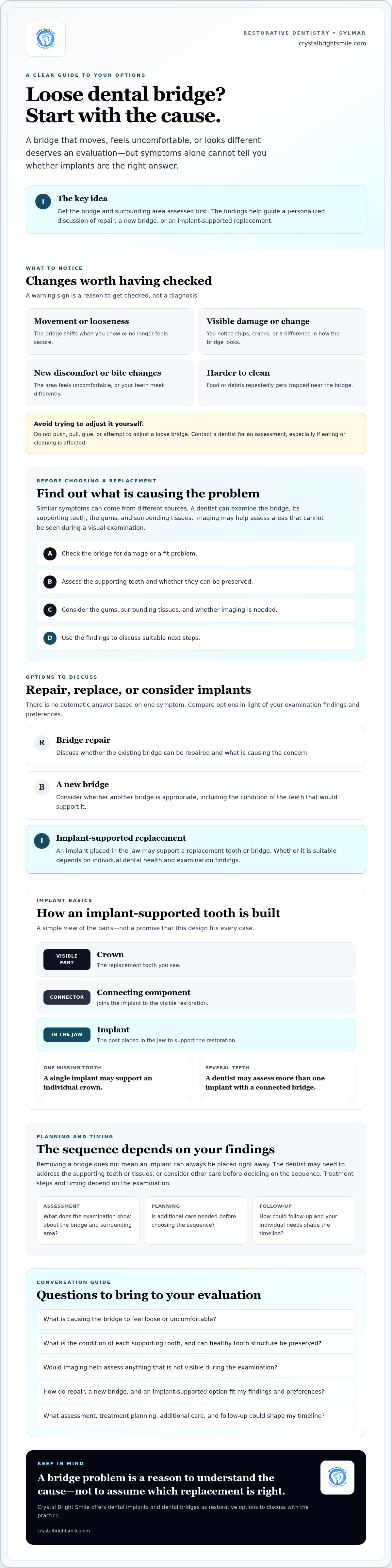
Arrange a dental evaluation if you notice looseness, visible chips or cracks, new discomfort, a change in how your teeth meet, or difficulty cleaning around the bridge. Repeatedly trapped food or debris near the bridge is also worth mentioning. A bridge or one of its supporting teeth may need attention even if you aren’t in pain.
A warning sign is a reason to get checked, not a diagnosis. Don’t push, pull, glue, or try to adjust a loose bridge yourself. Contact a dentist for an assessment, especially if the change is affecting eating or cleaning.
What might cause a bridge to fail?
Different problems can cause similar symptoms. The bridge itself may be damaged or no longer fit securely. A supporting tooth may have decay or damage, or changes in the gums and surrounding tissues may affect comfort and stability. These problems can be difficult to see at home, so appearance alone won’t tell you what’s wrong.
A dentist can examine the bridge, supporting teeth, gums, and surrounding tissues. Depending on the findings, appropriate imaging may help assess areas that aren’t visible during a visual examination. The results can help identify whether the concern involves the bridge, a supporting tooth, or another structure, and guide a discussion of next steps.
That assessment matters before you compare repair, a new bridge, or an implant-supported replacement. A Dental implant is placed in the jaw and may support a replacement tooth or bridge, but whether it’s appropriate depends on individual findings. Ask what the examination shows, whether imaging is needed, and which options address the specific problem. The aim is a plan based on your mouth, not an assumption based on one symptom.
How Implants Can Replace a Failing Dental Bridge in Sylmar
Once a bridge problem has been assessed, an implant-supported replacement may be one option to discuss. It differs from fitting another traditional bridge: an implant is placed in the jaw to support a replacement tooth, rather than relying on the same arrangement of teeth as anchors. For patients considering replacing a failing dental bridge with implants in Sylmar, the plan depends on findings about the bridge, supporting teeth, gums, and surrounding structures.
What happens to the bridge and supporting teeth?
The dentist considers whether the bridge can be repaired or needs to be removed, and whether its supporting teeth can be preserved. A loose or damaged bridge doesn’t automatically mean the teeth beneath it must be extracted. The condition of those teeth and the surrounding tissues helps shape the options. Repair or removal should follow an examination, not an assumption based on symptoms alone.
Ask what the assessment shows for each supporting tooth and whether healthy tooth structure can be preserved. If a tooth can’t be preserved, that may change the replacement plan. Understanding the condition of the whole area helps you compare repair, a new bridge, and an implant-supported option.
How does an implant-supported replacement work?
In simple terms, the implant is the post placed in the jaw, a connecting component joins it to the visible restoration, and the crown is the replacement tooth you see. For one missing tooth, a single implant may support an individual crown. If several teeth need replacement, a dentist may assess a plan with more than one implant and a connected bridge. The design depends on clinical findings, so an implant isn’t automatically suitable for every bridge failure.
Removing a bridge doesn’t mean an implant can always be placed right away. The dentist may need to address the condition of the supporting teeth or tissues, or consider other care before deciding on the sequence. Treatment steps and timing depend on your examination findings, including the health of the teeth and tissues around the bridge. Mayo Clinic’s overview of dental implant surgery provides general background on the procedure and factors a care team may consider.
For more on implant basics, read this dental implants guide. Crystal Bright Smile offers dental implants and dental bridges, so Sylmar-area patients can discuss how their individual findings relate to restorative options. Learn more about bridge and implant care as you prepare questions for that conversation.
Bridge Repair, a New Bridge, or Implants: Comparing Your Options
A failing bridge doesn’t point to just one solution. Depending on the condition of the bridge, supporting teeth, gums, and surrounding structures, a dentist may discuss repair, a replacement bridge, or an implant-supported option. Use the comparison below to prepare questions. Which option is suitable depends on examination findings and your goals.
When might repairing or replacing a bridge be discussed?
Repair may be considered if the problem can be addressed without replacing the whole restoration. A new bridge may be discussed if the existing one can’t be maintained and the supporting teeth and surrounding tissues are suitable. Neither option is automatically inferior. Ask what makes the bridge or its supports repairable, and how the recommendation accounts for your oral health and daily cleaning routine.
When might an implant-supported option be discussed?
If a bridge can’t be maintained, an implant evaluation may be one possible next step. Bone and gum health, medical history, the number of teeth involved, and your preferences can all inform that conversation. Replacing a failing dental bridge with implants in Sylmar isn’t a decision to make from symptoms alone. Ask the dentist to connect the recommendation to your examination findings and explain what alternatives remain.
For related restorative guidance, see this bridge-versus-implant comparison. If you’re weighing these options, you can also discuss bridge and implant care with Crystal Bright Smile.
Planning the Transition From a Failing Bridge to Implants
Moving from a failing bridge to an implant-supported replacement involves a sequence of decisions, not a one-size-fits-all procedure. If you’re considering replacing a failing dental bridge with implants in Sylmar, use the evaluation to clarify what needs attention, which options may be suitable, and who would provide each part of care. Here’s a practical outline:
Assessment: The dentist examines the bridge, supporting teeth, gums, and surrounding structures. Examination and any appropriate imaging can help identify what may be affecting the bridge and whether further care should be considered.
Options discussion: Review whether repair or a replacement bridge may be appropriate, alongside an implant-supported option. Ask what findings support each recommendation and whether any teeth or tissues may need attention first.
Treatment plan: If implants are being considered, ask which stages are included, who provides them, and whether referrals are needed. Clarify what happens to the existing bridge and what restoration is planned.
Follow-up: Discuss how progress will be reviewed, what aftercare is expected, and whom to contact with concerns. Follow-up needs depend on the plan and your clinical situation.
What should you ask during an implant evaluation?
Bring questions and ask for answers tied to your examination. For example: What appears to be causing the bridge problem? Which findings support that assessment? Could the bridge or supporting teeth be preserved? What alternatives should I consider? If implants are discussed, what are the treatment stages, potential risks, and aftercare needs? Ask who performs each stage and whether another provider or referral may be involved. These details help you understand the plan, not just the name of a treatment.
What factors can affect treatment sequence and healing?
Your oral health and individual health history can shape the order of care. The dentist may consider the health of your gums, supporting teeth, and jawbone before recommending a next step. Examination and imaging can help determine whether additional treatment is needed before implant placement or restoration.
There isn’t one timeline that fits every patient. Additional care and healing may affect when different stages can happen, so ask what could influence your schedule and how progress will be assessed. Don’t assume a treatment sequence or result before your clinical findings have been reviewed.
For more context on restorative options, explore this restorative dentistry guide. To discuss your bridge concerns and available restorative care, contact Crystal Bright Smile.
Explore Dental Implant Care Near Sylmar With Crystal Bright Smile
A bridge concern deserves a clear, personalized conversation, not an assumption that implants are automatically the answer. Crystal Bright Smile serves Sylmar and nearby communities and offers both dental implants and dental bridges. An evaluation can clarify what’s happening and which restorative options may be worth discussing based on your examination and goals.
What to bring to a dental bridge consultation
A little preparation can help you make the most of your visit. Note when you first noticed a change and what you’ve experienced, such as movement, discomfort, a bite change, or difficulty cleaning. Include relevant dental treatment history. If you have previous dental records or imaging available, bring them or ask how they can be shared.
Consider writing down questions, too. You might ask:
What could be causing the bridge concern, and what did the examination show?
Could the bridge be repaired or replaced, or might an implant-supported option be considered?
What treatment steps and aftercare could be involved?
Who would provide each stage, and would any referrals be needed?
How should I care for the area while a plan is being considered?
These questions can keep the discussion focused and help you understand the reasoning behind a recommendation. Mention your priorities, too, including comfort, cleaning, and what matters in your day-to-day routine.
How to take the next step in Sylmar
A consultation can help you understand the findings and possible next steps. It can’t establish implant eligibility or promise a particular outcome before your individual assessment. If implant treatment is discussed, ask which stages Crystal Bright Smile provides and whether any part of care would involve a referral. Knowing who handles each step can help you prepare and make informed decisions.
If you’re exploring replacing a failing dental bridge with implants in Sylmar, bring your concerns and questions to Crystal Bright Smile. The practice serves patients in Sylmar and nearby San Fernando Valley communities, including Tujunga, Burbank, Sunland, Glendale, Pasadena, La Crescenta, La Cañada, Sun Valley, Los Angeles, Sherman Oaks, Encino, Tarzana, and Pacoima. Contact Crystal Bright Smile to discuss an appointment. Start with the facts about your bridge, then review your options at a pace that supports an informed choice.
Take the Next Step Toward a Clearer Restorative Plan
A bridge that feels loose, uncomfortable, or changed deserves a professional assessment, but the symptom alone won’t determine the cause or the right solution. Repair, a new bridge, and an implant-supported replacement may all be worth discussing, depending on the condition of your bridge, supporting teeth, gums, and your goals. Replacing a failing dental bridge with implants in Sylmar begins with an individualized evaluation, not an assumption that implants are right for everyone.
Crystal Bright Smile offers dental implants and dental bridges. The practice is owned and operated by Dr. Marine Martirosyan, DDS. Bring your questions, available dental records, and concerns about treatment stages, healing, and referrals so you can better understand your options and who would handle each step.
Contact Crystal Bright Smile to discuss your dental bridge and implant options. A thoughtful conversation can help you move forward informed and prepared.
Frequently Asked Questions
Is it possible to replace a failing dental bridge with implants?
Yes, it may be possible, but a dental examination is needed first. A dentist will assess the bridge, supporting teeth, gums, jawbone, health history, and your preferences. Depending on the findings, options may include repairing or replacing the bridge, or discussing an implant-supported replacement. If you’re considering replacing a failing dental bridge with implants in Sylmar, ask how each option fits your situation rather than assuming implants are automatically right for you.
What are signs that a dental bridge may be failing?
Looseness, visible damage, discomfort, changes in your bite, or difficulty cleaning around a bridge deserve professional attention. These signs don’t identify the cause by themselves, and some concerns involving a bridge or supporting tooth may not cause obvious pain. A dentist can examine the bridge and supporting structures, then explain whether repair, replacement, or another form of care should be considered. Avoid trying to adjust a loose bridge yourself.
Is an implant better than a bridge for replacing a failing bridge?
Neither option is best for everyone. The decision may depend on the condition of your supporting teeth, gums, and bone, along with your health history, preferences, and treatment goals. An implant-supported replacement may be considered alongside bridge repair or replacement. Ask the dentist to explain the benefits, limitations, maintenance needs, and potential risks of each option based on your examination findings. A personalized comparison can help you decide with greater confidence.
Can a dental implant be placed immediately after a bridge is removed?
Not necessarily. The treatment sequence depends on what the dentist finds when assessing the bridge, supporting teeth, gums, and surrounding bone. Some patients may need additional care or healing before implant placement is considered. Your dentist can outline the proposed stages and explain why they’re recommended. Don’t rely on a standard timeline, since steps and timing can differ based on individual findings and the treatment plan.
How long does replacing a failing dental bridge with implants take?
The timeline varies with your oral health, treatment plan, and whether additional care or healing is needed. Implant treatment may include separate evaluation, treatment, and restoration stages, but the sequence isn’t the same for every patient. Once the dentist has assessed your bridge and relevant health factors, ask for a personalized outline of appointments, possible healing periods, and what could affect the schedule.
Does dental insurance cover replacing a bridge with implants?
Coverage varies by plan, policy terms, and the treatment recommended, so don’t assume an implant or bridge replacement will be covered in full. Ask the dental office for a treatment estimate and the proposed procedure codes, then request a benefits review from your insurer. For more background, read this dental insurance guide. Crystal Bright Smile serves Sylmar and nearby San Fernando Valley communities.

Comments