


Told You Need All Your Teeth Pulled? What to Do Next

Could a recommendation to remove every tooth be a reason to ask more questions, rather than a decision you have to make today? If you’re thinking, “I was told I need all my teeth pulled what should I do,” it’s understandable to feel frightened, overwhelmed, or unsure about the plan. Full-mouth extraction may be considered when widespread gum disease or severe tooth damage leaves teeth with a poor outlook, but you deserve a clear explanation of your diagnosis.
Before deciding, ask what makes each tooth difficult to save and whether any teeth could be treated instead. Another evaluation can help you understand the findings and compare options, though it can’t guarantee that extraction will be avoidable. Bring your dental records and X-rays, and share the recommendation you received.
This article explains why full-mouth extraction may be recommended, what questions and records can support another evaluation, and how dentures, implants, or full-mouth reconstruction may fit into a personalized plan. At Crystal Bright Smile in Tujunga, California, treatment recommendations depend on your examination, dental condition, goals, and clinical needs. The aim is to help you make an informed decision without pressure.
Table of Contents
Told You Need All Your Teeth Pulled? First Understand the Recommendation
Hearing that all your teeth may need to be removed can feel shocking. It’s reasonable to pause, ask questions, and expect a clear explanation before agreeing to a major treatment plan. If you’re thinking, “I was told I need all my teeth pulled what should I do,” begin by finding out what the dentist observed and why the proposed plan applies to your mouth.
A full-mouth extraction means removing all remaining natural teeth. The recommendation may reflect problems affecting several parts of the mouth, rather than one isolated tooth. But the phrase alone doesn’t tell you which teeth are affected, what the examination showed, or whether the dentist considers the plan urgent. Those details matter. General background on the procedure is available in this Tooth Extraction Overview, but your dentist must explain how your clinical findings shape the recommendation.
What does a recommendation to remove every tooth mean?
A treatment plan and an emergency decision aren’t necessarily the same thing. A dentist may recommend removing all remaining teeth because of widespread concerns, then discuss timing and replacement options as part of a planned conversation. Ask whether the recommendation applies to every tooth and what makes the overall plan preferable to treating individual teeth. Extraction isn’t automatically necessary, and whether any teeth can be preserved depends on their condition and your examination.
If pain or a possible infection is involved, seek timely professional assessment rather than trying to judge the cause yourself. Contact a dental professional promptly, especially if symptoms are worsening. An assessment can help determine what needs attention and how quickly; symptoms alone can’t establish whether all teeth need to be removed.
Which details should the dentist explain?
Ask for a tooth-by-tooth explanation in plain language. For each tooth considered non-restorable, invite the dentist to describe the findings behind that conclusion. Relevant concerns may include extensive decay, a fracture, infection, or damage to the gums and supporting bone. Ask what the examination and any imaging show, and whether any teeth may have a different treatment outlook.
Which teeth are considered non-restorable, and what specific findings support that assessment?
Are decay, fractures, infection, or gum and bone concerns affecting the recommendation?
What could happen if treatment is delayed, based on my examination?
Is there time to understand the plan and consider other suitable approaches?
You don’t need to know dental terminology to ask these questions. If an explanation feels unclear, ask the dentist to show you the relevant area on your records or imaging and explain what it means for your options. The goal isn’t to challenge a recommendation for its own sake. It’s to understand the diagnosis, the reasoning, and the next decision in front of you.
How Dentists Assess Whether Teeth Can Be Saved
A recommendation about the whole mouth should be based on more than a quick look at one painful tooth. The dentist evaluates each tooth and the tissues around it, including the gums and the bone that supports the teeth. The goal is to understand the condition of individual teeth and how those findings fit into an overall treatment plan.
Decay, cracks or fractures, infection, and reduced periodontal support can all affect whether a tooth may be restorable. A problem in one area doesn’t mean every tooth has the same outlook. For example, one tooth might have extensive damage while another has a different clinical picture. Only a treating dentist can interpret your examination and imaging in context.
“Treatment recommendations depend on examination findings, your goals, and your individual clinical needs.” Imaging and existing dental records may help clarify what the dentist sees, but they should be explained alongside the clinical examination. For general information about the procedure itself, MedlinePlus offers an overview of what tooth extraction involves.
What findings may affect a tooth’s prognosis?
A dentist considers how much healthy tooth structure remains, whether damage extends below the gumline, whether infection is present, and how much support the surrounding tissues provide. These factors can influence which treatments are worth discussing, but no single finding automatically determines the outlook for every tooth. Your dentist must interpret your examination and images before recommending a course of care.
Why a tooth-by-tooth explanation matters
Ask for a written breakdown of which teeth are proposed for treatment and the reason for each recommendation. This makes it easier to separate teeth that may need removal from those for which restorative care could be considered. It also gives you a useful record to review when comparing explanations or planning next steps.
Which teeth are being considered for extraction, and what finding supports each recommendation?
Could a crown or root canal therapy be appropriate for any specific tooth?
What maintenance or follow-up might be involved with a tooth-preserving option?
How does the condition of the surrounding gums and supporting bone affect the overall plan?
A crown or root canal isn’t suitable for every tooth, and preserving one tooth may or may not make sense within the broader plan. The decision depends on that tooth’s condition and how it fits with your overall dental needs. If you’re still asking, “I was told I need all my teeth pulled what should I do,” a careful review can help turn a broad recommendation into clearer individual decisions.
At Crystal Bright Smile in Tujunga, treatment planning is personalized to each patient’s examination, dental condition, and goals. An individual dental evaluation can help clarify the findings and options to discuss.
Compare Tooth-Preserving Care, Dentures, and Implant Options
There isn’t one treatment path that fits every mouth. Depending on your examination, options may include treating selected teeth, replacing teeth with dentures, or discussing implant-supported restorations. These approaches serve different purposes and aren’t interchangeable. Use the comparison below to organize a conversation about your needs, not to decide candidacy on your own.
When might preserving some teeth be discussed?
A crown, root canal therapy, or periodontal treatment may be considered if the examination suggests a tooth is suitable for preservation. Each approach has a different purpose, and treatment may require follow-up or ongoing care tailored to your condition. Ask which teeth could be treated and what maintenance the plan would involve. No treatment can guarantee that a tooth will last or remain symptom-free.
How do dentures and implant-supported options differ?
Dentures replace missing teeth with an appliance, while implants are a different treatment category that can support a restoration. A full-mouth reconstruction may combine approaches when the individual plan calls for it. Compare comfort, function, care at home, treatment timing, and budget with your dentist. The right discussion starts with your goals and clinical needs, not a promise that one option is best for everyone.
If you’re thinking, “I was told I need all my teeth pulled what should I do,” ask the dentist to explain which options apply to your specific findings and why. At Crystal Bright Smile in Tujunga, restorative care, dentures, dental implants, and full-mouth reconstruction are part of the practice’s treatment offerings. Recommendations and candidacy vary from person to person and depend on your examination, goals, and clinical needs.
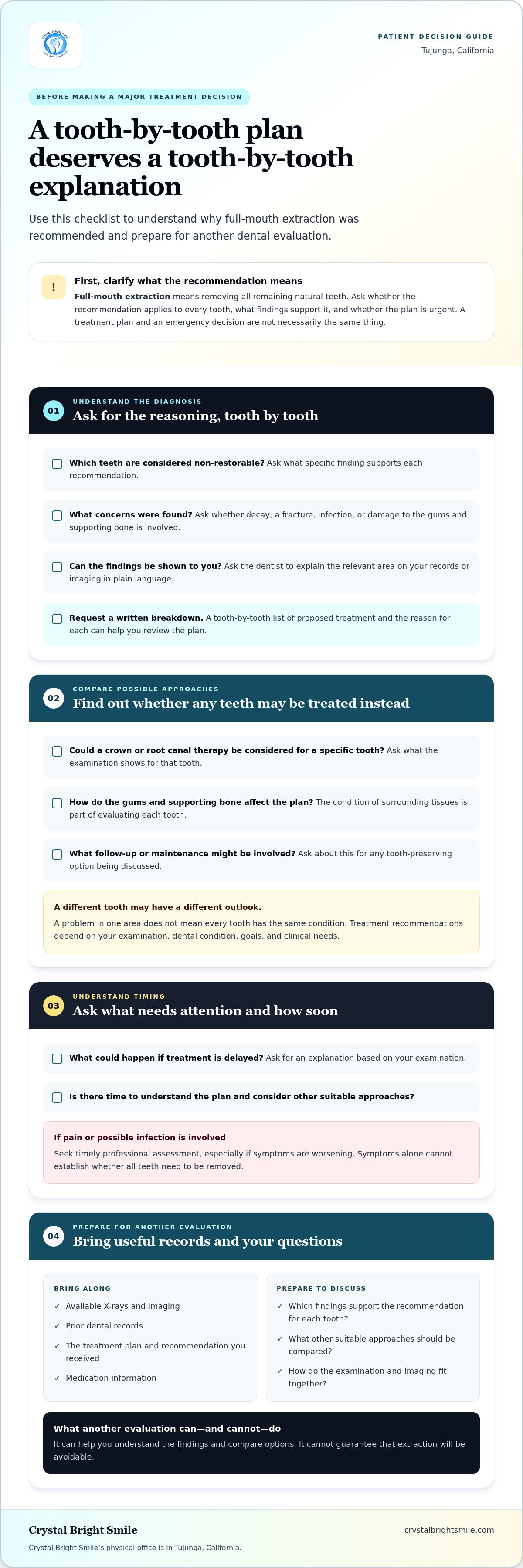
How to Get a Second Opinion and Prepare for the Visit
A second opinion can give you another professional perspective on the diagnosis and proposed plan. It doesn’t guarantee a different recommendation, but it can help you understand the reasoning and feel more prepared to decide. If you’re wondering, “I was told I need all my teeth pulled what should I do,” take a steady, organized approach.
Request your records. Ask for copies of relevant dental records, imaging, and the written treatment recommendation.
Write down your questions. Include concerns about urgency, alternatives, risks of waiting, and how care might be staged.
Schedule an evaluation. Share the original recommendation and bring the information you’ve gathered.
Compare the explanations. Focus on the diagnosis, findings, reasoning, and proposed next steps, not only whether the recommendations match.
Questions to bring to a second-opinion appointment
A short list can help you use your appointment well. Ask which teeth may be restorable and what findings make other teeth difficult to treat. Discuss reasonable alternatives, including their limitations and potential maintenance needs. Ask what could happen if treatment is delayed, which symptoms require prompt attention, and what timeline is clinically appropriate for your situation.
Also ask whether treatment would happen in stages and what determines the order. A clear explanation should connect each recommendation to your examination and needs. If an answer uses unfamiliar terms, ask for a simpler explanation or a visual reference. It’s fine to take notes or bring someone you trust to help you remember the discussion.
What to bring and what to compare
Gather what’s available before the visit. Your original written plan, relevant images, prior dental records, and a current medication list can help provide context. Include information about previous dental treatment or changes in your health that may be relevant. If you don’t have every record, bring what you do have and note what’s missing.
Compare the clinical reasoning, not just the final procedure suggested. Two evaluations may differ in how they interpret a finding or approach a complex plan. Ask each dentist to explain what evidence supports the diagnosis, which options were considered, and how the plan relates to your goals and clinical needs. Write down anything that remains unclear so you can address it before making a decision.
Don’t use a second opinion to postpone urgent care. Severe or worsening pain, swelling, or other concerning changes call for prompt professional assessment. A dentist can advise you about urgency based on an examination; symptoms alone can’t establish what treatment is needed. If you’re unsure whether to wait for a scheduled opinion, seek timely dental guidance.
Crystal Bright Smile in Tujunga, California, provides individualized dental evaluations to help patients understand findings and discuss appropriate treatment paths. Schedule a dental evaluation to review your concerns and questions with the dental team.
Discuss Your Options With Crystal Bright Smile in Tujunga
If you’re still asking, “I was told I need all my teeth pulled what should I do,” an individualized evaluation can help you understand the diagnosis and consider which paths may fit your needs. Crystal Bright Smile’s physical office is in Tujunga, California, and the practice serves nearby communities including Sunland, La Crescenta, Montrose, Shadow Hills, and Lake View Terrace.
The dental team includes Dr. Nazy Rafieyan, a general dentist with more than 30 years of clinical experience, and Dr. Souren Rostomyan, a board-certified oral and maxillofacial surgeon with more than 20 years of experience. Depending on your examination and clinical needs, a discussion may include restorative dentistry, dentures, dental implants, extractions, or full-mouth reconstruction. These are different approaches, and an evaluation is needed to understand which options may be suitable for you.
What to expect from an individualized treatment discussion
Your dental condition is central to planning, alongside your clinical needs, goals, and budget. The team uses modern dental technology and personalized treatment planning to support clear communication about the findings and possible next steps. Bring your questions, too. You can talk about comfort, chewing and other functional needs, appearance, and how treatment might be sequenced.
Ask for a clear explanation of the proposed plan, including which parts are intended to address current dental problems and which relate to replacing or restoring teeth. If more than one path may be appropriate, ask about the differences, potential limitations, maintenance, and what each could involve. If a recommendation is unclear, request an explanation in everyday language. Understanding the reasoning can make a complex decision feel more manageable.
Take the next step without feeling rushed
You’re allowed to ask questions and take time to understand the options presented to you. A conversation about treatment doesn’t commit you to a particular procedure. It gives you space to review the diagnosis, raise concerns, and discuss how choices relate to your priorities.
Before your appointment, consider writing down what matters most, such as preserving any teeth that may be treatable, planning for replacement teeth, comfort, timing, or budget. You can also bring your existing treatment plan and dental records so the discussion has useful context. Recommendations and candidacy for restorative care, dentures, implants, extractions, or full-mouth reconstruction depend on your individual examination and clinical needs.
For patients in Tujunga and nearby service areas, Crystal Bright Smile welcomes a discussion about your diagnosis, alternatives, treatment costs, and available financing options. Contact the practice to review costs and financing details that apply to your situation, and to discuss your questions with the dental team.
Take Your Next Step With Clarity
A major dental decision can feel like it asks you to choose your entire future at once. It doesn’t. Your next step can simply be a conversation that helps you understand what needs attention now and which decisions deserve more discussion. You’re allowed to seek clarity before committing to a plan, while still taking urgent symptoms seriously.
If the question “I was told I need all my teeth pulled what should I do” is still weighing on you, let it guide the questions you bring to your next appointment. Share what matters most, whether that’s preserving teeth, comfort, appearance, function, or planning care around your budget. You don’t need to have every answer before the visit. The goal is to leave with a clearer sense of your choices and possible next steps.
Crystal Bright Smile’s team can discuss your dental needs and potential treatment paths based on your individual circumstances. Schedule an evaluation with Crystal Bright Smile and take a calm, informed step toward a plan shaped around your clinical needs and goals.
Frequently Asked Questions
Can all my teeth be saved if I was told they need to be pulled?
Possibly, but it depends on the condition of each tooth and its supporting structures. One tooth may be considered for a crown or root canal therapy while another may have a different outlook. Ask for the reasoning behind the recommendation for each tooth, including what treatment could involve and what follow-up it may require. Only an examination can determine which options are appropriate for your situation.
Should I get a second opinion before having all my teeth removed?
A second opinion can be helpful if the recommendation isn’t an emergency and you want another assessment before deciding. Bring the proposed treatment plan and any available records or images, and explain what you’d like clarified. If you have severe or worsening symptoms, seek prompt professional care rather than waiting for another appointment. A second opinion can support an informed choice, but it shouldn’t delay urgent evaluation.
What happens if I wait before having my teeth pulled?
The effects of waiting vary with the reason for the recommendation and your current dental condition. Ask the dentist what risks apply in your case, how soon treatment is advised, and whether any interim care may be suitable. Don’t assume that waiting is either harmless or automatically dangerous. A clinician who examines you can explain a reasonable timeline and what changes should prompt you to seek care sooner.
Are dentures or dental implants alternatives to having all my teeth pulled?
Dentures and implant-supported restorations may be discussed if teeth need replacement, but they don’t necessarily replace treatment that could preserve a tooth. These options differ in how they’re planned and maintained. Ask how each choice may affect daily function and what care it involves. For people exploring care in Tujunga, Sunland, La Crescenta, Montrose, Shadow Hills, or Lake View Terrace, candidacy still depends on an individual examination and clinical needs.
Can I have all my teeth removed in one appointment?
Not necessarily. Whether extractions can be completed together or need to be staged depends on your health, dental findings, and overall treatment plan. Ask why the proposed schedule is recommended, what recovery planning involves, and how replacement teeth fit into the timing. A clinician can explain whether completing treatment in one appointment is appropriate for your circumstances. Don’t assume a single-visit approach is suitable for every patient.
How do I prepare for a dental second opinion about full-mouth extraction?
Bring the written recommendation, relevant dental records or images, and a current medication list if available. Note your symptoms, concerns, and questions beforehand, including whether any teeth might be treatable and what supports the proposed plan. You can also write down what matters most to you, such as function or treatment timing. This preparation gives the dentist useful context without presuming what the evaluation will find.
Is a full-mouth extraction always followed by dental implants?
No. Removing teeth doesn’t automatically mean implants are the next step. Depending on your examination, goals, and clinical needs, a dentist may discuss dentures, implant-supported restorations, or another treatment plan. Ask what replacement options are relevant to your situation, how they differ in daily care, and how the proposed plan addresses function over time. An individual assessment is needed to determine whether a particular option is suitable.

Comments