


Tooth Pain Years After a Root Canal in Encino: Causes and Next Steps

What if tooth pain years after a root canal doesn’t automatically mean the tooth must be removed? If you’re experiencing unexpected discomfort long after your procedure, it’s understandable to worry that treatment has failed or wonder whether the soreness is coming from another tooth or area. Pain that returns after a long quiet stretch deserves attention, but it can have several possible causes.
This article explains what may be behind the discomfort, which symptoms call for prompt or urgent dental care, and how an examination can help clarify what to do next. A dentist may review your symptoms, examine the area, and use dental imaging to guide an individualized recommendation. Crystal Bright Smile provides root canal therapy and emergency dental care at its physical office in Tujunga, California, serving nearby communities including Sunland, La Crescenta, Montrose, Shadow Hills, and Lake View Terrace. Treatment options depend on examination findings, your dental condition, goals, and clinical needs, so a diagnosis comes before conclusions about retreatment, a crown, or extraction.
Key Takeaways
Pain in tooth years after root canal Encino is a symptom to assess, not proof on its own that the tooth has failed.
Several issues can feel similar, so an exam of the treated tooth and nearby areas can help clarify the possible cause.
A dental evaluation may include a symptom history, examination, and appropriate imaging to guide next steps.
Care recommendations may range from monitoring or restoration repair to retreatment, depending on the findings and the tooth’s condition.
For recurring, persistent, or worsening pain, Crystal Bright Smile’s physical office is at 7738 Foothill Blvd, Tujunga, California.
Table of Contents
Tooth Pain Years After a Root Canal in Encino: What the Symptom Can Mean
When discomfort returns after years without symptoms, it can be unsettling. If you’re in Encino and experiencing pain in a tooth years after a root canal, it’s understandable to worry that treatment has failed or wonder whether the discomfort is coming from another tooth or area. Pain alone can’t answer that. It’s a symptom to assess, not automatic proof that the root canal has failed or that the tooth needs to be removed.
Root canal treatment addresses tissue inside a tooth, but the tissues around its roots, gums, and neighboring teeth can still contribute to discomfort. The pattern can offer useful clues, though it can’t confirm the cause. A general Root Canal Treatment Overview explains the procedure and its purpose, while a dental examination helps assess new symptoms in their individual context.
What can pain in a root-canaled tooth feel like?
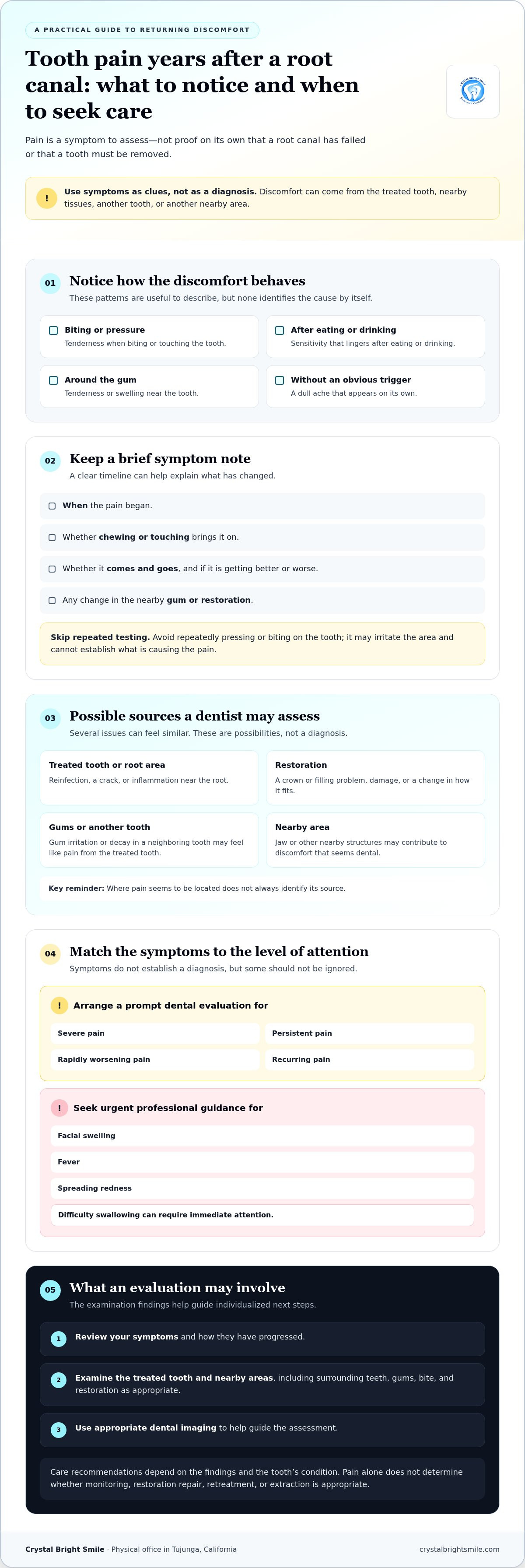
Notice how the discomfort behaves. Pressure or tenderness when biting may feel different from sensitivity that lingers after eating or drinking. Gum tenderness near the tooth, a dull ache that appears without an obvious trigger, or swelling in the area are other patterns to describe. These sensations don’t point to one cause by themselves, but details about their timing and triggers can help a dentist assess the tooth and surrounding tissues.
Keep a brief symptom note: when the pain began, whether chewing or touching the tooth brings it on, whether it comes and goes, and whether it’s getting better or worse. Also note any change in the nearby gum or restoration. Avoid repeatedly pressing or testing the tooth, which may irritate the area and won’t establish what’s causing the pain.
Which symptoms call for prompt attention?
Arrange a prompt dental evaluation for severe, persistent, rapidly worsening, or recurring pain. Facial swelling, fever, spreading redness, or difficulty swallowing call for urgent professional guidance. Difficulty swallowing can require immediate attention. These signs don’t establish a diagnosis, and not every episode of discomfort is an emergency, but they shouldn’t be ignored or left for self-diagnosis.
If you’re in Encino and the pain keeps returning or is changing, seek professional assessment rather than waiting for a particular pattern to prove what’s wrong. Share your symptoms and how they’ve progressed. The next step depends on an examination, because pain near a treated tooth can come from the tooth, nearby structures, or another source. Crystal Bright Smile’s Tujunga office serves patients from nearby communities, including Sunland, La Crescenta, Montrose, Shadow Hills, and Lake View Terrace. Getting the area assessed can replace guesswork with a clearer understanding of what care may be appropriate.
Why Can a Tooth Hurt Years After Root Canal Treatment?
A root-canaled tooth can hurt for reasons involving the tooth itself or nearby structures. Treatment addresses tissue inside the tooth, but a later change in the tooth, its restoration, the gums, or surrounding tissues may produce discomfort. Even symptoms that feel familiar can have different explanations, so a dentist needs to assess the tooth and surrounding area before recommending care.
For someone searching about pain in tooth years after root canal Encino, the key point is that pain can have several possible causes. Crystal Bright Smile’s physical office is in Tujunga, California, and serves nearby communities such as Sunland, La Crescenta, Montrose, Shadow Hills, and Lake View Terrace. Possible causes of renewed discomfort include reinfection, a crack, a restoration problem, or inflammation near the root. Gum irritation, decay in another tooth, or discomfort referred from a nearby area may also be involved. These are possibilities, not a diagnosis. Pain alone doesn’t prove that retreatment or extraction is necessary.
Can infection or inflammation develop around a treated tooth?
Bacteria may persist in or re-enter a tooth if there’s a problem with the original treatment or if the tooth or restoration develops a new opening or damage. This can allow irritation or infection to develop in the area. Tenderness near the root or discomfort when chewing may occur, but neither symptom confirms infection. A dentist considers the full examination and appropriate imaging before determining whether infection or another cause is present.
Inflammation around the root can also cause tenderness without making the reason obvious from how the pain feels. A crown or filling that no longer seals well, new decay, or changes in the tooth may be relevant. The timing of symptoms can help guide an evaluation, but it can’t establish what’s happening inside or around the tooth.
Could a crack, crown, or neighboring tooth be involved?
A crack in the tooth or damage to a crown or filling may cause discomfort, particularly with biting or pressure. A restoration can also need assessment if it feels loose, has a visible change, or no longer seems to fit comfortably. Avoid testing a suspected crack by repeatedly biting down. Report what you notice and let the dentist examine the tooth.
Gum irritation or decay in a neighboring tooth may feel as if it’s coming from the previously treated tooth. Jaw or other nearby structures can also contribute to discomfort that seems dental. Perceived pain location does not always identify its source. That’s why an evaluation may include checking nearby teeth, the gums, the bite, and the restoration, rather than focusing only on the tooth with a root canal.
The appropriate next step depends on the examination findings, the tooth’s condition, and your individual needs. If discomfort persists or returns, a dental evaluation and root canal care can help you discuss the findings and possible options without assuming in advance that the tooth must be retreated or removed.
How a Dentist Evaluates Tooth Pain After a Root Canal in Encino
An evaluation for pain in tooth years after root canal Encino involves more than a quick look at the treated tooth. The dentist gathers a symptom history, examines the tooth and surrounding areas, considers whether imaging is appropriate, then discusses the findings with you. Crystal Bright Smile’s physical office is in Tujunga, California, and serves patients from nearby communities, including Sunland, La Crescenta, Montrose, Shadow Hills, and Lake View Terrace.
What should you share during the appointment?
Specific details help the dentist understand how the discomfort behaves. Before your visit, consider noting:
When the discomfort began and whether it has changed.
Where you feel it, and whether it is constant or comes and goes.
What seems to trigger it, such as chewing, temperature, or pressure.
Whether it wakes you or occurs without an obvious trigger.
When the root canal and any crown or other restoration were completed.
Share relevant dental history, including recent treatment or changes you’ve noticed around the area. You don’t need to identify the cause yourself. A useful description might be, “It hurts when I chew on that side, but not at rest,” or “The soreness comes and goes.” These observations help focus the examination without treating a symptom pattern as a diagnosis. If you have records about the original procedure or restoration, bring them if convenient.
What can an examination and dental X-ray help assess?
The dentist may check the treated tooth, how your teeth meet when you bite, the condition of the crown or filling, gum tissue, and neighboring teeth. They may assess tenderness or look for visible damage and changes around the restoration. Examining nearby structures matters because discomfort that seems to come from one tooth may have another source.
A dental X-ray may help show the roots and surrounding bone, including visible changes around the root or nearby teeth. It’s one assessment tool, not a guaranteed explanation for every symptom. Some cracks or other problems may not be clear on a standard image, and an image must be considered alongside your history and clinical findings. The dentist decides whether imaging is appropriate and what it can contribute to the evaluation.
Then comes a clear discussion. The dentist can explain what the examination and any images do or don’t show, whether more assessment is needed, and which next steps may fit your situation. Monitoring, repairing a restoration, or considering further treatment are possibilities only when supported by the findings. Recommendations depend on your dental condition, goals, and clinical needs, not simply on the fact that discomfort has returned.
Treatment Options When Pain Returns After Root Canal Treatment
There isn’t one automatic treatment for pain in a tooth that has had a root canal. The recommendation depends on what the evaluation finds, how much healthy tooth structure remains, whether the restoration is intact, and the condition of the surrounding tissues. Sometimes monitoring is appropriate; in other cases, a specific problem may call for repair or further treatment. Pain by itself doesn’t determine which option fits.
When might a dentist discuss retreatment or restoration repair?
If the findings point to a treatable issue within the root canal system, a dentist may discuss retreatment. This generally involves reopening the tooth to address the canal system and seal it again. Whether it’s suitable depends on the cause of the symptoms and the tooth’s overall condition. It isn’t a recommendation that can be made from pain alone.
A different approach may be considered if the concern involves a crown, filling, or other restoration. Depending on the examination, a dentist may recommend repairing or replacing a restoration, or monitoring an area when no immediate treatment is indicated. These options aren’t interchangeable: a restoration repair won’t address every problem within a root canal, and retreatment isn’t automatically needed just because a restoration needs attention.
For broader context, restorative dentistry addresses ways to repair or replace damaged tooth structure. The specific recommendation for a previously treated tooth still depends on its examination findings, dental condition, and clinical needs.
Does recurring pain mean the tooth must be removed?
No. Recurring pain alone can’t establish whether a tooth is restorable or must be extracted. The dentist considers the extent of any crack or damage, how much usable tooth structure remains, the state of the root and surrounding tissues, and what the examination shows. A tooth with a problem may have options to consider, but no outcome can be promised before those details are assessed.
If a tooth can’t be predictably restored, extraction may be discussed as one possible next step. That decision should follow an evaluation and a conversation about the findings and appropriate options, rather than a conclusion based only on discomfort. The aim is to make an informed plan that accounts for the individual tooth and your needs.
Ongoing dental care also helps place a single tooth concern in the context of your overall oral health. General family dental care can include evaluations and treatment planning based on individual needs; it doesn’t replace a focused assessment of the painful tooth.
If pain has returned, arrange an evaluation before deciding that retreatment or extraction is inevitable. Schedule a dental evaluation to discuss your symptoms and possible next steps. Recommendations depend on examination findings, your dental condition, goals, and clinical needs.
Encino Tooth Pain: Crystal Bright Smile in Tujunga
Recurring, persistent, or worsening discomfort is a reason to arrange a dental evaluation, not to guess at the cause. If you’re concerned about pain in tooth years after root canal Encino, an appointment can help clarify what may be happening and which next step, if any, is appropriate. Treatment recommendations depend on examination findings, your dental condition, goals, and clinical needs.
Crystal Bright Smile’s physical office is at 7738 Foothill Blvd, Tujunga, CA 91042. The practice provides root canal therapy and emergency dentistry in a fully digital dental office, with personalized treatment planning and clear communication. Patients from nearby communities, including Sunland, La Crescenta, Montrose, Shadow Hills, and Lake View Terrace, can access care at the Tujunga office. Digital technology supports the evaluation process, while the dentist’s findings guide the discussion and recommendations.
How can you prepare for a dental visit?
A few notes can help you describe the problem clearly. Before your appointment, record when the pain began, where you feel it, what seems to trigger it, and whether it has changed. If you have information about the original root canal or a crown or other restoration, bring it along. You can also note questions you want answered.
Does the examination suggest the pain is coming from this tooth or another area?
What did the examination and any imaging show?
What options may be appropriate, and why does the recommended next step fit my situation?
You don’t need to arrive with a diagnosis. Your observations and dental history give the dentist useful context, and questions can help you understand the findings and feel more informed about the plan.
What should you expect from individualized care?
There’s no single treatment plan for every tooth that becomes uncomfortable after a root canal. The condition of the tooth, the surrounding tissues, your goals, and the clinical findings all matter. The dentist can explain whether the evaluation points toward monitoring, restorative care, or another approach, and discuss the reasoning with you. No specific outcome can be promised before an examination.
Dr. Nazy Rafieyan is a general dentist with more than 30 years of clinical experience. At Crystal Bright Smile, the team can review your concerns and discuss options based on your individual needs. Clear answers begin with a careful assessment, not assumptions about retreatment or extraction.
If the discomfort is recurring, persistent, or getting worse, take the practical next step and arrange an evaluation. Call Crystal Bright Smile at (818) 352-8200 or visit the practice website to arrange a dental appointment. An evaluation can help guide the conversation without presuming what treatment you may need.
Take the Next Step With Clarity
Uncertainty can make a returning ache feel more overwhelming than it needs to be. If you’re dealing with pain in tooth years after root canal Encino, try not to decide what it means before a dentist has assessed it. Your next step isn’t to choose a treatment in advance. It’s to get enough information to make that choice thoughtfully.
An evaluation can help turn concern into a clearer conversation about what the findings show and what options may fit your individual needs. You can ask questions, understand the reasons behind a recommendation, and take time to consider the plan. The right path depends on your clinical situation, but you don’t have to navigate the uncertainty alone.
Arrange a dental evaluation with Crystal Bright Smile to discuss your symptoms and possible next steps. A calm, informed conversation is a meaningful place to begin, and clearer information can help you move forward with greater confidence.
Frequently Asked Questions
Can a root-canaled tooth still hurt if its nerve was removed?
Yes. Root canal treatment removes tissue from inside the tooth, but the ligament and other tissues that support it can still register pain. A sore gum or nearby tooth may also make it seem as though the treated tooth is responsible. For example, discomfort only while chewing may be useful to report, but it can’t pinpoint the cause. Note when symptoms occur and whether they change.
Can sinus pressure feel like pain in an upper tooth after a root canal?
It can be hard to tell whether discomfort in an upper tooth is related to dental tissues or nearby facial pressure. Neither the location nor a feeling of fullness confirms a sinus cause, and a dental issue may feel similar. Notice whether chewing changes the discomfort and mention facial pressure or other symptoms at your appointment. A dental assessment can help consider possible sources instead of relying on sensation alone.
Can antibiotics alone fix pain in a tooth that had a root canal?
Antibiotics alone may not address the cause of pain in a previously treated tooth, and they aren’t appropriate for every dental problem. A clinician should determine whether medication is needed and what other care may be indicated. Don’t take leftover antibiotics or someone else’s prescription. If pain is worsening or you have swelling or fever, seek professional dental guidance rather than trying to manage it with medication on your own.
Should I avoid chewing on a tooth that hurts after a root canal?
If chewing makes the tooth hurt, avoid repeatedly biting down to test it. You might choose softer foods and chew on the other side temporarily if that feels comfortable. This can reduce provocation, but it doesn’t show what’s causing the pain or treat the underlying issue. Arrange an evaluation if symptoms continue or worsen. Facial swelling, fever, or trouble swallowing calls for urgent professional guidance.
Can pain go away and still be worth discussing with a dentist?
Yes. A break from pain doesn’t confirm that its cause has resolved. If it returns, becomes more frequent, or follows a recent dental procedure, note when it appears and fades, what you were doing, and whether anything else changed. Sharing that timeline can make your appointment more useful, even if you’re comfortable at the moment. Mention any swelling or changes around the tooth as well.
How soon should I make an appointment for recurring tooth pain?
Arrange an evaluation if pain persists, keeps returning, or is getting worse; don’t wait for it to become constant. Facial swelling, fever, spreading redness, or difficulty swallowing warrants urgent professional guidance. If you’re in Tujunga or a nearby community such as Sunland, La Crescenta, Montrose, Shadow Hills, or Lake View Terrace, explain the pattern and any changes when contacting Crystal Bright Smile so the team can help arrange an appropriate dental evaluation. Symptoms alone can’t establish a diagnosis or determine the care needed.

Comments